Top Scenario Modeling Software for Startups: Features and Comparisons
August 3, 2026
Owen Bitas
Finance leaders often scramble to understand how ownership will shift when a fundraising event lands on the cap table. Yet many still rely on static spreadsheets to model these changes. Without context for how ownership evolves round to round, they're forced to make critical decisions with incomplete information.
Small modeling errors, such as underestimating how a SAFE converts, can disrupt hiring plans or result in employees, founders, or investors having less equity than expected. Scenario modeling software lets finance leaders forecast how the cap table will shift before finalizing decisions. But to be useful, it must reflect the company's equity data and structure, not a simple version built in isolation.
To help you compare scenario modeling software, we'll look at what each platform can actually simulate. You'll see which platforms are equipped to handle complex rounds and which fall short. We'll also show you how Pulley lets you explore multiple scenarios and optimize ownership allocation in real time, before anything is finalized.
A comparison chart further down lays out how the equity-focused tools measure up on the features that matter most, so you can scan the trade-offs before reading each write-up.
What is scenario modeling software?
Founders and CFOs can get a clearer view of how ownership evolves under different funding structures with accurate scenario planning. That could include a new funding round, an equity grant, or a change in valuation. Scenario modeling software should reflect your cap table’s actual structure, enabling your finance team to test outcomes before making any changes.
The best platforms handle items like SAFEs, convertible notes, dilution events, and refresh grants without more spreadsheets. They help decision-makers understand how ownership shifts and which outcomes carry the most impact. The right scenario modeling software connects to your equity data, allowing you to evaluate trade-offs before they impact control or future terms.
Why spreadsheets break down
Spreadsheets are often the first tool used to model a cap table because they’re accessible and easy to customize. But as your company grows, that flexibility can become a liability. Updating ownership by hand after each round or grant invites errors, and they compound.
Since they’re not connected to live data, spreadsheets can’t dynamically show how SAFEs convert, how refresh grants affect dilution, or how new rounds impact existing stakeholders. As your business grows more complex, it becomes harder to trust the numbers. Connecting your model to real-time data provides a clearer view of trade-offs before they hit your cap table, so you can make informed decisions.
If you’ve ever tried to map out dilution in a spreadsheet, you know how quickly things get complicated. Pulley’s guide to modeling dilution breaks down how these dynamics play out and why accurate scenario planning matters.
How modern tools help finance leaders scale
Modern scenario modeling software addresses these gaps by connecting directly to your cap table and valuation data. With live inputs in place, simulations reflect your current ownership structure in real time.
Finance leaders can explore funding outcomes and share investor-ready numbers in minutes instead of rebuilding a model each time. Instead of rebuilding a model for every round, finance leaders get a repeatable system they can trust for equity decisions as the company grows.
Key features to look for in scenario modeling software
Not all scenario modeling software can handle the complexity involved in startup equity planning. Many focus on general forecasting without accurately modeling your specific equity structure.
Look for features that tie equity planning to the actual impact on ownership, including:
- Real-time cap table integration: Tools that sync with your live cap table reduce guesswork by pulling in real ownership data and reflecting the equity already in play. Strong tools update automatically as ownership changes, so you avoid manual re-entry after each round or grant.
- Support for SAFEs, convertible notes, and option pool resizing: Your tool should be able to handle pre- and post-money SAFEs, notes with discounts or caps, and option pool adjustments before or after the round.
- Side-by-side scenario comparisons: Seeing different round structures side by side helps founders and CFOs align on trade-offs early, before committing. Running what-if analysis across rounds lets you model a SAFE conversion, an option pool top-up, or a down round and see each outcome before you commit.
- Built-in modeling for dilution, valuations, and employee equity: The strongest tools reveal how dilution plays out over time and how employee equity value evolves as the company grows.
- Exportable reports for board and investors: Your modeling tool should produce clean, export-ready outputs that support board discussions and investor updates without requiring additional formatting.
- ASC 718 and 409A visibility: Forecasting tools with built-in visualization reveal how equity decisions affect expense recognition and valuations, reducing surprises during due diligence. Tied into your scenario planning process, they help model how pricing changes or new grants impact dilution.
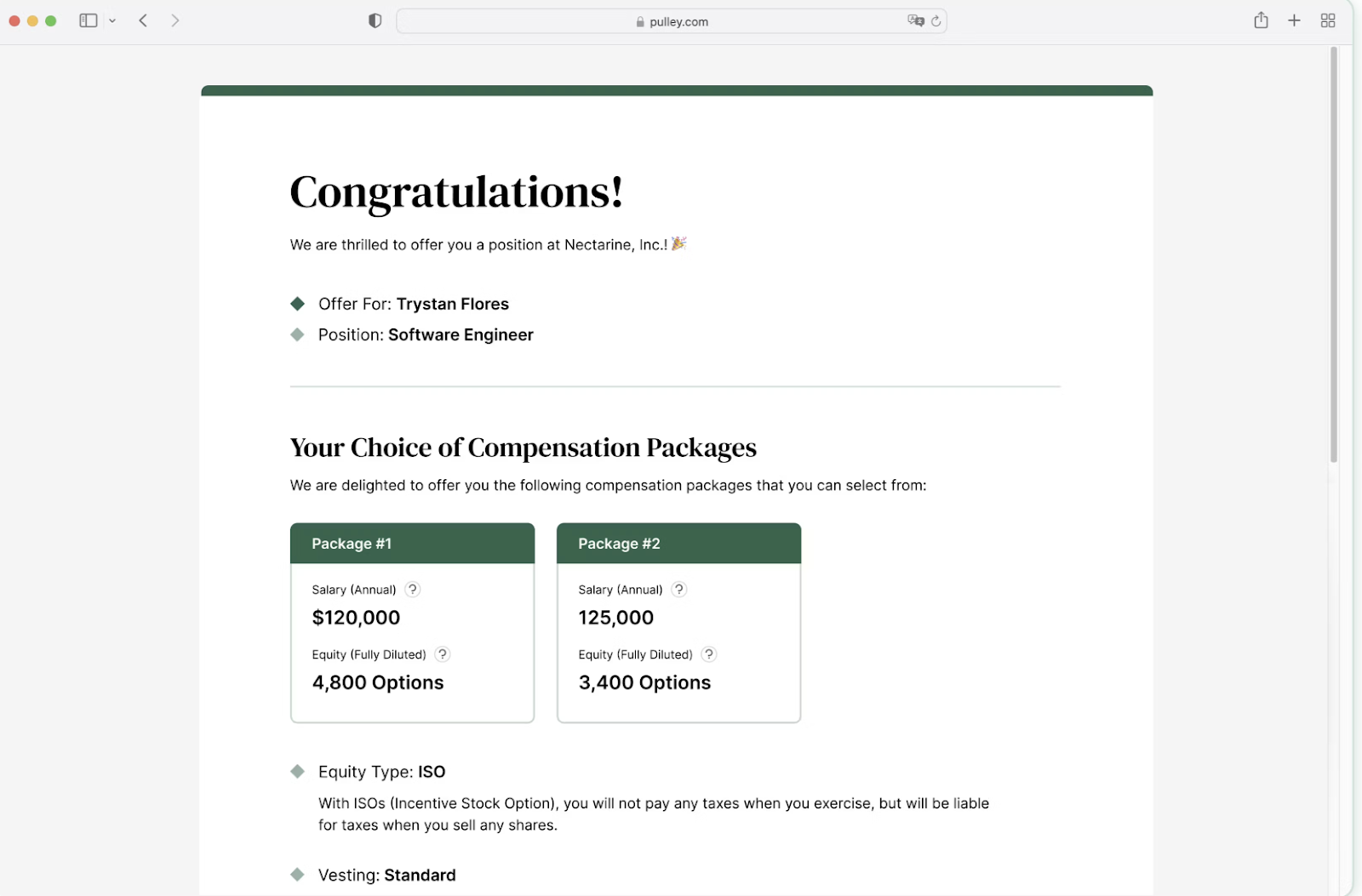
Before committing to a tool, make sure it accurately reflects your current equity structure and updates automatically as ownership changes. Your data stays in sync as changes occur, and you won't be relying on outdated inputs.
The best scenario modeling software for startups (ranked by use case)
Choosing the right scenario modeling software depends on how closely it aligns with your startup's equity decision-making process. Some platforms support broader financial planning, while others specialize in cap table modeling and ownership forecasting.
We've ranked these tools based on the startup scenarios where they perform best, from all-in-one equity planning to investor-mandated platforms and lightweight financial modeling. For a broader view of equity platforms, Pulley's cap table management software guide offers a helpful breakdown.
Pulley: Best for most startups and growing companies
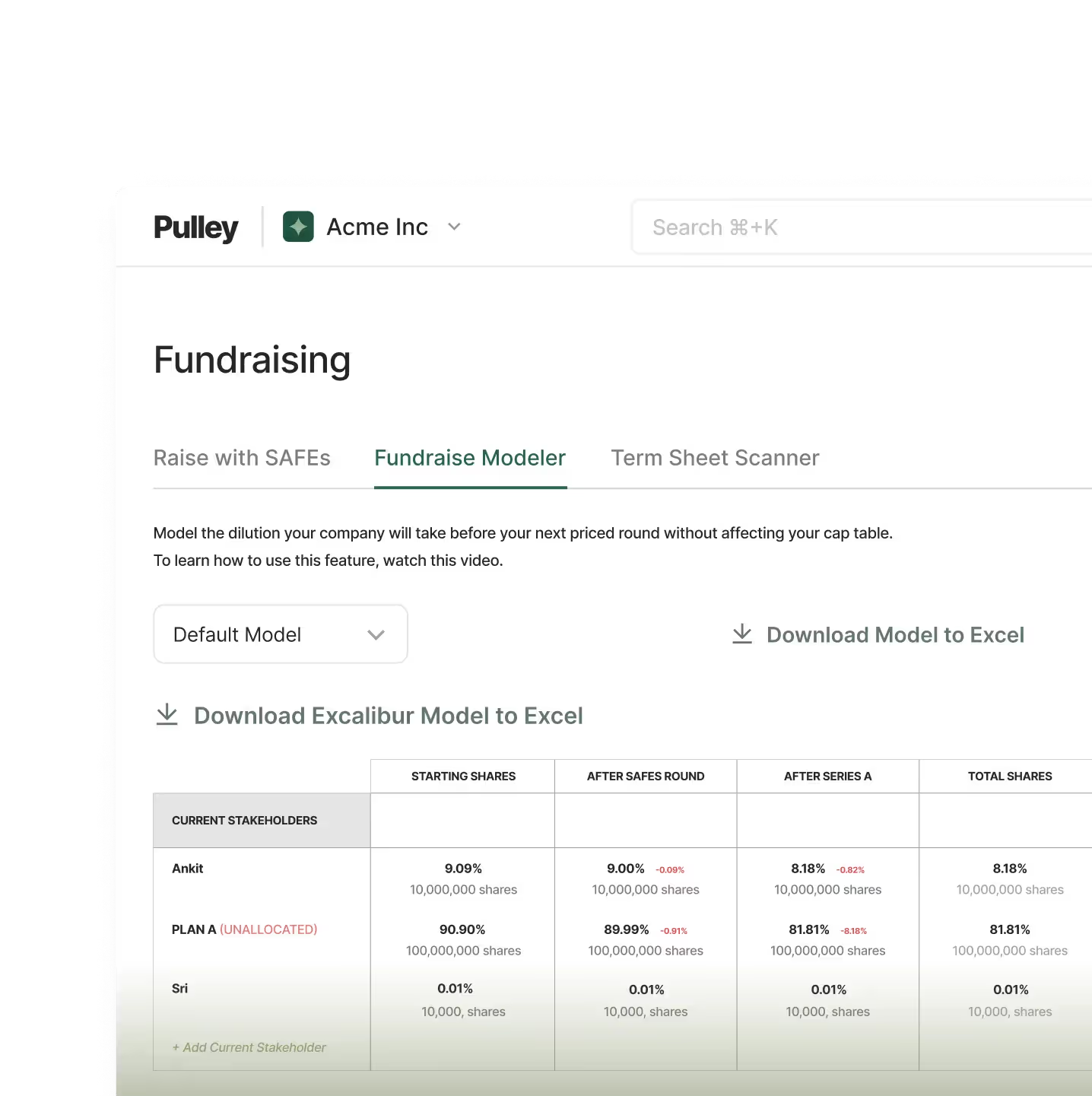
Pulley's software solution for scenario modeling integrates directly with its cap table, 409A, and ASC 718 tools, so every simulation reflects live equity data. Founders and finance leaders can model SAFEs, pro-rata rights, and option pool changes in real time, then compare different scenarios visually and export reports built for board or investor review.
If you need a refresher before modeling, Pulley's Equity Terms Guide breaks down key terms, enabling decision-makers to model confidently.
Pulley also supports the more complex modeling needs of growth-stage companies, such as managing multiple rounds, modeling secondary sales, or preparing for audits and due diligence. It also helps finance leaders move fast and stay aligned on ownership and compliance at every stage of growth.
Pros:
- All-in-one solution for scenario modeling, cap table management, 409A, and ASC 718
- Live equity data integrated directly into every simulation
- Intuitive interface for both founders and finance teams
- Built to scale from early-stage through later fundraising rounds
Cons:
- Less known among investors who default to Carta (despite more modeling functionality)
- May involve switching platforms if a startup begins on another cap table tool
See Pulley's scenario modeling software in action. Request a demo today.
Carta: Best for companies already embedded in the platform
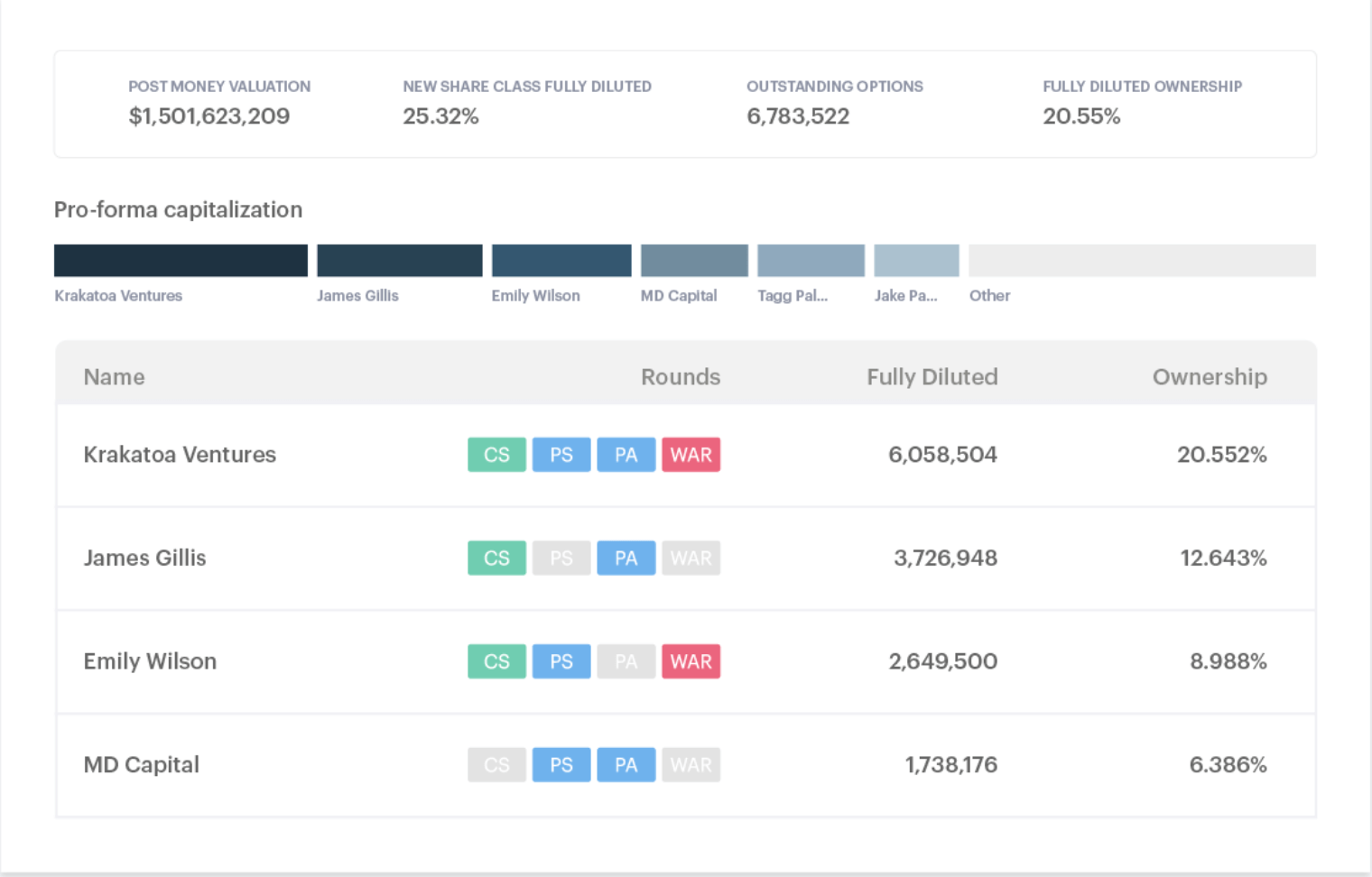
Carta offers scenario modeling on its paid plans, with only limited fundraise tooling on the free Launch tier. The friction for many startups is integration: valuations run as a separate flow, so it takes more manual work to see how funding terms affect ownership in one place.
For companies already embedded in Carta's platform, the modeling tools can be serviceable. But for startups looking to connect scenario planning with live equity data, integration is the limit: because valuations run as a separate flow, funding terms and 409A data don't sync automatically the way the cap table does.
Pros:
- Widely used by startups and offers basic cap table management features.
- For companies already using the platform, its modeling tools add some convenience without requiring a full switch.
Cons:
- Deeper modeling and 409A valuations sit on paid tiers; because valuations run separately, some inputs still need manual updates to stay in sync.
- Since Carta manages valuations separately, users find it harder to see how funding terms affect ownership in real time.
Eqvista: Best for early-stage teams with simple equity needs
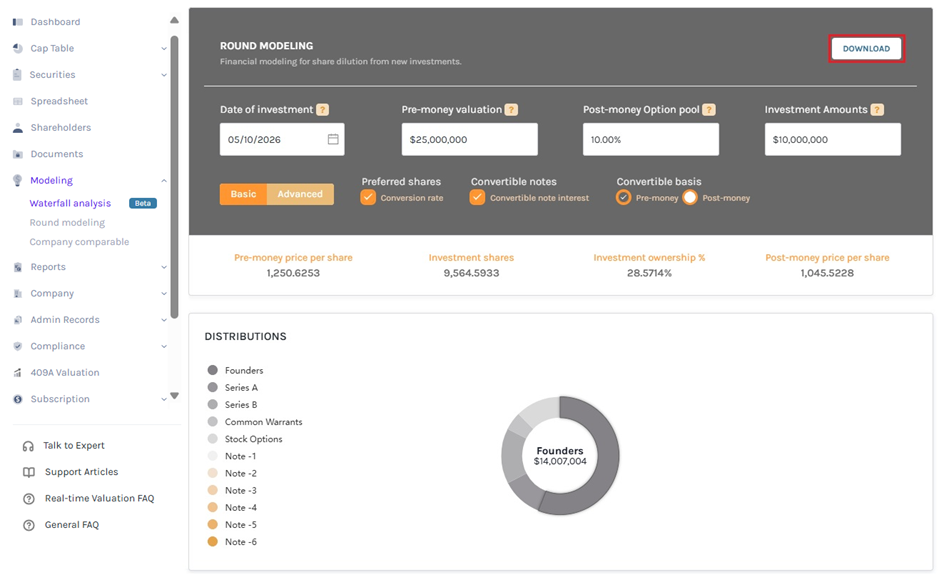
Eqvista keeps cap table tracking straightforward, making it a reasonable fit for early-stage founders who mainly need to see who owns what. It also includes round modeling and waterfall analysis, so you can estimate how a new round dilutes existing holders and how proceeds would split at exit.
Its modeling works from the cap table, but it centers on ownership and exit outcomes rather than the detailed fundraising scenarios growth-stage teams tend to run. For companies with simple equity, that tradeoff is often fine.
Pros:
- Clean, approachable interface that early-stage founders can pick up quickly
- Built-in round modeling and waterfall analysis tied to the cap table
- Free tier for smaller stakeholder counts, with transparent per-stakeholder pricing above that
Cons:
- Less suited to complex fundraising scenarios, such as stacked SAFEs with varied terms
- Advanced modeling and 409A support sit on paid tiers, so early plans cover the basics
Forecastr: Best for teams that don't need equity planning support
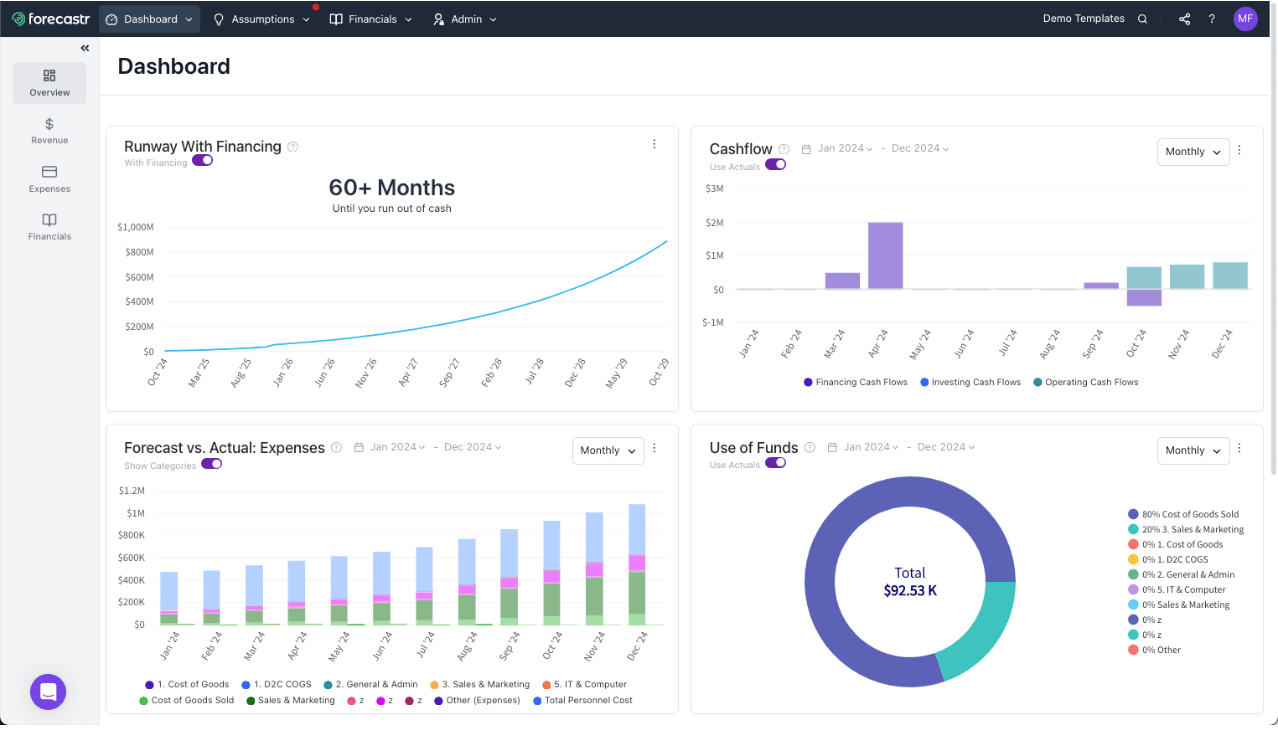
Forecastr excels in financial forecasting, particularly in cash flow and revenue projections. But because equity isn't its focus, detailed cap table and dilution modeling typically still happen elsewhere. Unlike Pulley, startups typically pair Forecastr with a second tool, such as Carta, to handle cap table and dilution modeling. The result is a more complex and costly planning stack.
Pros:
- It excels in financial planning, making it easy to model burn and runway
- It's especially helpful for founders focused on cash management and top-line forecasting
Cons:
- Its focus is financial forecasting rather than equity management, so cap table and dilution modeling aren't its core strength
- Most companies end up pairing it with a separate platform to gain a full picture of ownership and dilution
FlowCog, Jirav, and Cube (honorable mentions)
These tools focus on budgeting, ARR, and burn tracking. While useful for finance-stack visibility, they aren't designed for equity modeling or fundraising simulations. They may suit CFOs looking to round out a broader financial planning toolkit, but they don't incorporate detailed cap table data or equity mechanics.
Without access to the actual cap table, they can't model how a round dilutes ownership or connect scenarios to real stakes, pro-rata rights, or option pool dynamics.
Scenario modeling software comparison chart
Among the tools above, only some model equity directly, and those differ most on how tightly they connect to your cap table and how much they handle without manual work. The matrix below compares the four equity-relevant platforms on the capabilities that shape a fundraising decision.
¹ Carta and Eqvista: 409A and ASC 718 sit on paid tiers; on Carta, 409A runs as a separate valuation flow.
² Eqvista: round and waterfall modeling covers standard rounds and exits, but is lighter on complex or stacked SAFE structures and side-by-side multi-scenario comparison.
³ Forecastr: models financial scenarios such as revenue, burn, and runway, not equity or dilution.
Pulley and Carta sit closest on raw capability, so the decision usually turns on integration, how valuations flow, and pricing, which a direct comparison of the two platforms lays out in detail. Eqvista fits teams with simpler equity, while Forecastr sits outside equity modeling entirely, better paired with a cap table tool than used as one.
Why Pulley leads for fundraising scenario modeling
Fundraising impacts every part of the cap table, but many tools treat it as a basic modeling exercise with limited visibility into ownership details. Pulley takes a more comprehensive approach.
Scenario modeling is integrated directly into the equity platform, so every simulation reflects live ownership, grant schedules, and 409A valuation data. This full integration eliminates manual imports and lets you start modeling right away.
Pulley’s fundraising modeling simulates SAFEs, pro-rata rights, and option pool adjustments in detail. You can preview pro forma ownership for each participant, see how different terms affect dilution, and generate outputs that are ready for investor decks.
Since the software pulls from your real cap table, you can run different scenarios without versioning errors or last-minute cleanups.
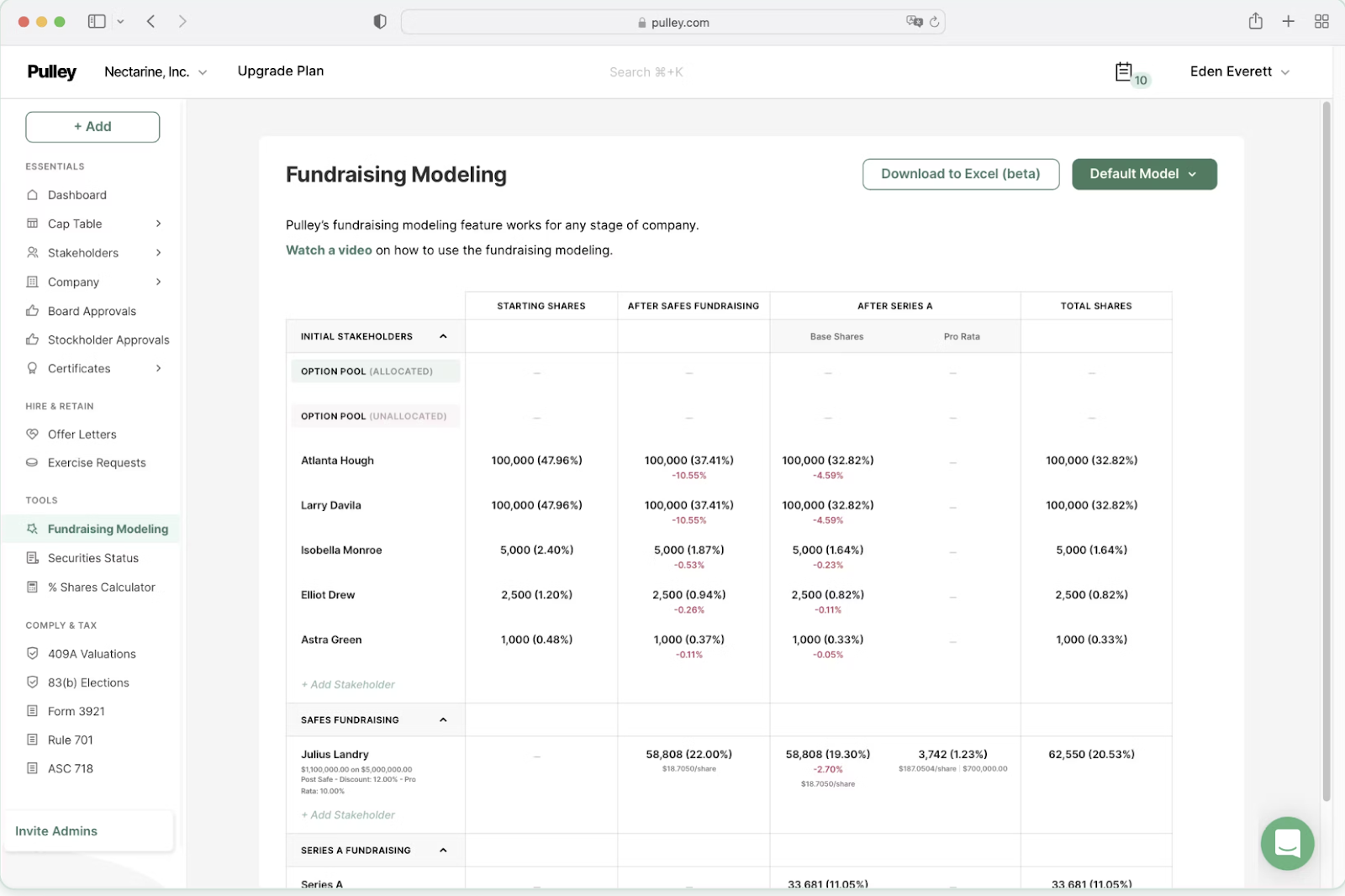
Scenario modeling gives users an edge when preparing for a round or negotiating terms. Pulley helps finance leaders move quickly by showing how each decision affects ownership now and in possible future rounds.
For growth-stage startups, real-time data and audit-ready reports make it easier to get through diligence without last-minute cleanup. That kind of clarity also keeps growth on track for companies scaling quickly.
Pick the right software solution for your startup stage
Selecting the right scenario modeling software depends on what you need to plan. Early-stage teams focused on cash flow may find that tools like Forecastr cover the basics. Once ownership considerations start impacting decisions, however, your scenario modeling software must be able to accurately reflect your cap table.
General-purpose tools often fall short. They can’t simulate how SAFEs convert or how an option pool shift affects founder ownership. Without a connection to actual equity data, it’s easy to make decisions that unravel later.
Equity decisions this consequential shouldn't rest on a spreadsheet. Book a demo to see how Pulley models outcomes against your actual cap table.
Scenario modeling FAQs
What is scenario modeling software used for in startups?
Scenario modeling software provides startups with the visualization they need to see how decisions like fundraising or hiring will impact ownership before anything is finalized.
How does Pulley's scenario modeling differ from Carta or Excel?
Pulley connects to your live cap table and valuations, so you can model complex rounds without manual updates or hidden errors. Unlike Excel, which relies on static data and fragile formulas, Pulley keeps everything current automatically.
Do I need scenario modeling software if I already use Forecastr or Jirav?
Forecastr and Jirav are built for financial planning, not equity modeling. If you're raising capital or issuing equity, you'll need a tool that ties directly to your cap table.
Can I use scenario modeling for employee equity planning?
Yes. Pulley's offer letter tool reveals how equity value changes in relation to future valuations, providing workforce planning teams with a realistic view of total compensation.
Is Pulley's scenario modeling included with the cap table platform?
Yes, Pulley's scenario modeling is built in, so equity planning and fundraising stay in one place.
How is scenario modeling software different from financial forecasting tools?
The difference is what each one models: scenario modeling software works from your cap table to show how a round, grant, or exit changes ownership and dilution, while financial forecasting tools model revenue, burn, and runway across your financial statements.
Tools like Forecastr, Jirav, and Cube handle the forecasting side but don't track equity or connect to your cap table. If you need to see how a decision affects who owns what, you need scenario modeling; for its effect on cash and P&L, you need forecasting. Many finance teams run both.
Switch to Pulley
Pulley simplifies equity management - Cap tables, 409a valuations, SBC reporting, scenario modeling, SAFEs, RSUs, options, and more.

By subscribing you agree to our Privacy Policy.