Carta 409A Valuation: Costs, Process, and Alternatives (2026)
June 10, 2026
Aaron Yeung
A 409A valuation can make or break your next audit or funding round. The bar is high in 2026: auditors dig deeper into methodology and data sources, investors scrutinize assumptions, and boards expect airtight documentation. A poorly prepared 409A valuation report might satisfy a checkbox today, but under real scrutiny, it can unravel fast. If you're a founder or CFO evaluating 409A providers, we'll walk you through what separates a defensible valuation from one that creates problems down the line.
Pulley and Carta are two of the most searched options for 409A providers. But the similarities between the two mostly stop at name recognition. Carta's valuation methods and how its team is staffed can impact whether your numbers hold up under auditor or investor scrutiny.
The differences matter when every assumption gets questioned. Pulley's in-house valuation team prepares reports that hold up in real audits and give CFOs and controllers the confidence to identify risks early and stand behind their numbers. If you're a founder or CFO evaluating 409A providers, this guide walks through what separates a defensible valuation from one that creates problems down the line.
Why 409A valuations matter more than ever in 2026
Once a compliance checkbox, a poorly executed 409A valuation is now a strategic liability and a complicating factor for fundraising. Closer IRS scrutiny and the rise of secondary sales mean the margin for error is shrinking, and the potential implications of a valuation that cuts corners are more serious. Investors are also applying more due diligence pressure, often requiring up-to-date valuations before committing capital.
Section 409A of the Internal Revenue Code establishes acceptable approaches for determining the fair market value (FMV) of a company's common stock. This valuation sets the strike price for employee stock options and supports IRS compliance, including Form 3921. Companies file Form 3921 when employees exercise Incentive Stock Options (ISOs), enabling the IRS to track and enforce tax liability.
A third-party valuation that follows recognized standards grants safe harbor status — meaning the IRS will accept it unless it can prove the valuation unreasonable. Most private companies use independent appraisals to document FMV and stay compliant.
A weak valuation has real consequences. Strike prices set below FMV expose employees to immediate tax liability and penalties. Auditors who question your methodology can delay your financial close or require a restatement. Investors running due diligence will press on assumptions — and a report that can't withstand that scrutiny can stall a round. For CFOs managing ASC 718 reporting, a poorly performed 409A creates a shaky foundation for every stock-based compensation calculation that follows.
The risks of treating 409As like a commodity
When defining recognized standards, things get murky. Audit firms look closely at who prepared the report, the sources of financial data, and whether it supports the fair market value you report to the IRS.
Valuations based on internal datasets or automated models look credible but may not hold up under scrutiny. Unclear methods and assumptions raise questions during review. Some valuation firms use the Probability Weighted Expected Return Method (PWERM), which weighs exit scenarios like IPO or acquisition. While PWERM is valid, its results depend on assumptions that reflect your company’s actual outlook.
Even small errors in 409A valuations complicate equity planning and create compliance concerns for pre-IPO companies.
What is Carta's 409A valuation service and how does it work?
Carta offers 409A valuations alongside its equity compensation management platform. For companies already using Carta for cap table management, the integration keeps valuation data and equity records in the same system, reducing the need to transfer data between providers.
For early-stage companies with straightforward capital structures, Carta's valuation process begins with an automated pricing model. Human reviewers are involved later, though the degree of analyst involvement varies by company size and plan tier.
A typical Carta 409A engagement follows this sequence:
- Kickoff and data collection: Carta requests your cap table, financial statements, funding history, and incorporation documents. Completeness determines how quickly the process moves.
- Analysis and draft delivery: Carta's valuation team runs the models, applies the chosen methodology, and produces a draft report. This phase typically takes one to two weeks.
- Review and revisions: You can request revisions or ask questions about the assumptions used. The final report is delivered after revisions are incorporated.
- Final report: The completed valuation is delivered within the platform.
Carta does not publicly list standalone valuation pricing. Costs are bundled into broader platform subscriptions, making it difficult to understand valuation costs upfront.
The Carta 409A valuation process: Key risks to understand
The biggest difference between 409A providers isn't the software. It's who's doing the valuation, the approach they use, and whether they stand behind it.
Audit risks from weak ownership and analyst inexperience
Redwood Valuation, a third-party firm, raised concerns in 2023 about the experience level of Carta's in-house valuation team. It highlighted:
- Average experience per analyst: 3.3 years
- Estimated 50+ analysts with fewer than 2 years of experience
- No named analyst assigned to reports
- Reports are unsigned, meaning Carta is not legally accountable if challenged during an audit
Some early-stage customers have also reported that more experienced analysts are reserved for larger companies, and that personnel assigned to a valuation may change between engagements. Per its own product release notes and website, Carta's initial valuations begin with an automated pricing model. While human reviewers are involved later in the process, the initial valuation is automatically generated, which can limit early-stage companies' access to specialized review and direct analyst interaction. This lack of ownership can lead to ambiguity in financial statements and cause issues in due diligence, audits, or public filings.
Flawed data inputs
A key concern with Carta's valuation approach is the data it relies on. Rather than sourcing independent market comparables or using external financial benchmarks, Carta pulls data from its own customer base. This means that:
- Internal data is not independently validated or publicly auditable
- Companies are compared using opaque success or failure weightings rather than clear financials
- A company's own financial data could indirectly influence another client's valuation, even without explicit consent
- If the SEC or IRS reviews a report built this way, every data point may need to be disclosed and defended
Carta has also had issues in the past when their team contacted cap table clients about its secondary market business, raising concerns about how customer data was being handled.
Audit concerns and red flags
Concerns are growing that Carta's 409A methodology may not hold up under audit scrutiny. The documented concerns include:
- Recent reports have omitted total equity value and total enterprise value, raising questions about whether conclusions are supportable, per an analysis by Venture First
- Appraisers are generally required to certify assignments under USPAP standards — failure to list responsible appraisers could create audit challenges
- Despite discontinuing its "hybrid" approach following audit feedback, some reports still carry disclaimers stating they are "not intended for financial reporting," raising concerns about ASC 718 compliance
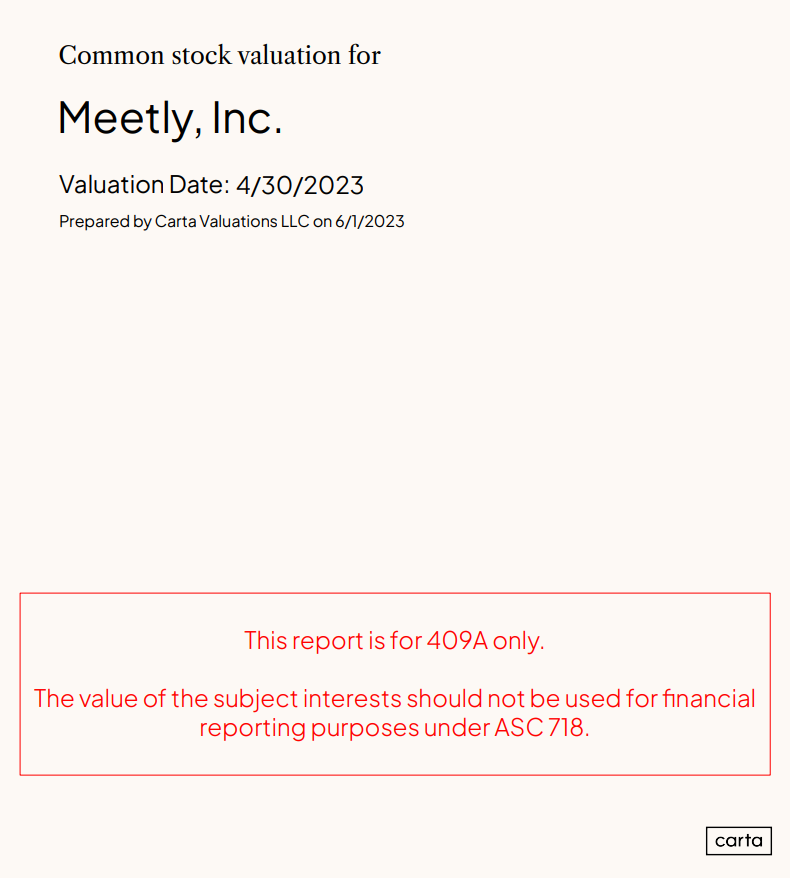
- Carta's use of aggregated private-company data blurs the line between platform data and independent analysis
Carta's valuation process is often described as a "black box," meaning founders, CFOs, and legal teams may have limited insight into how the numbers are calculated. Their limited transparency can trigger additional scrutiny that a startup may not be equipped to resolve.
Pulley's 409A valuation service: designed for audit-readiness
Pulley approaches its valuations differently. Every detail is built to withstand audits and provide finance leaders with confidence when the stakes are high.
Credentialed, in-house experts
Pulley doesn't rely on generic reports. Instead, every 409a valuation is prepared by a knowledgeable, experienced, dedicated analyst, who stays with you through every step of the process. If an auditor has questions, your analyst can walk them through the methodology. And with Pulley, you get lifetime support for your 409A valuation needs.
Defensible, independent data
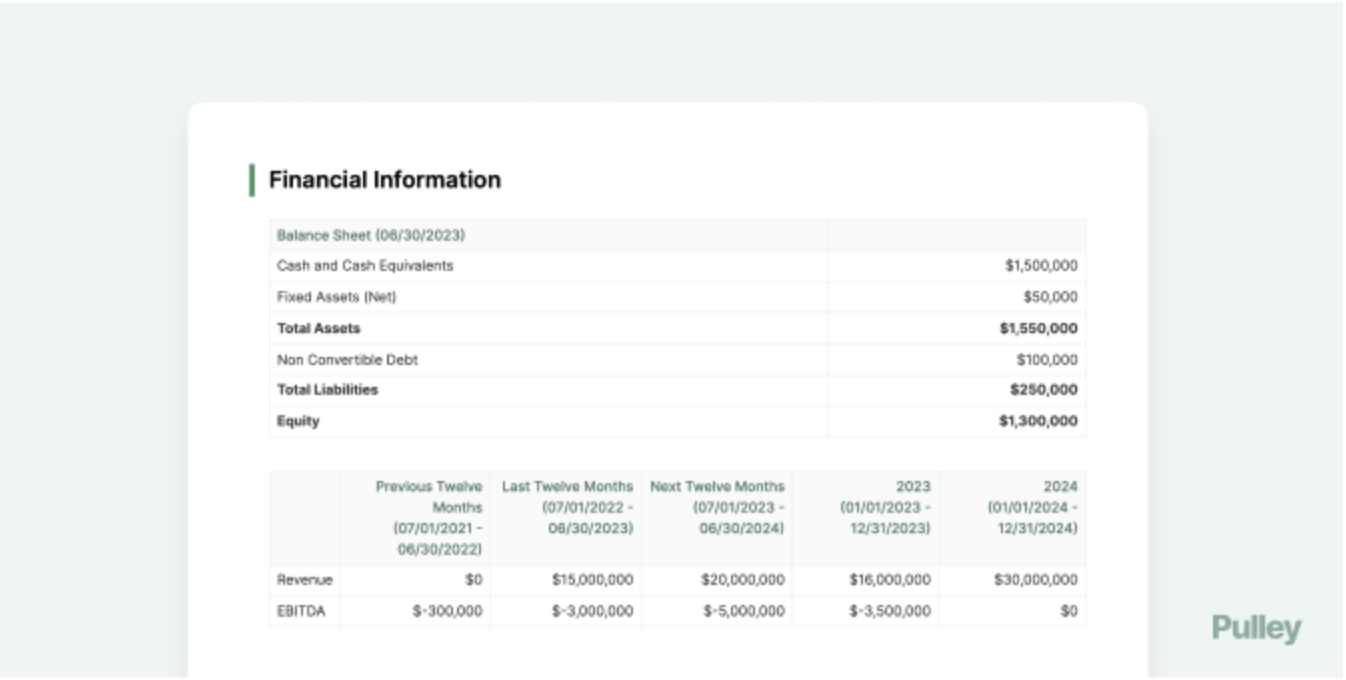
Pulley uses publicly available comparables and trusted financial databases to ground its valuations, not internal customer data. Every source is external, auditable, and tied to your company's actual metrics, creating an objective foundation that auditors trust.
Pulley's valuations reflect where your business stands in the actual market, drawn from independent data sources rather than another platform's proprietary pool. Pulley discloses exactly which comparables informed the valuation. It clearly explains any discounts using established audit-approved practices, resulting in a valuation that's fair, transparent, and defensible.
Built-in compliance confidence
Pulley's reports meet both IRS standards and financial audit requirements. This dual compliance provides safe harbor protection and manages ASC 718 alignment in the same document. For CFOs preparing ASC 718 stock-based compensation disclosures, Pulley's reports include the FMV inputs, volatility assumptions, and methodology documentation that auditors need to sign off on SBC expense calculations. No separate valuation engagement required.
Each Pulley valuation comes as a 60+ page report outlining:
- Methods used and why they were chosen
- All inputs and their sources
- Detailed rationale for key assumptions
Pulley takes responsibility for defending its valuations. If questions arise, their team works directly with auditors to explain the methodology in detail. In fact, auditors have reviewed over 2,000 Pulley valuations without a single failure.
"We don't cut corners to deliver fast valuations—we build them to hold up. If it ever comes to an audit, we don't just hand you a PDF. We're in the room with you."
— Pulley Valuation Team
Speed, support, and transparency
Most companies receive a draft valuation from Pulley in just a few business days. Your analyst remains involved from the moment you submit your materials. You get consistent support through each step without being left guessing how the report was created.
Pulley makes its pricing easy to understand, with plan tiers listed clearly upfront. The Growth plan includes:
- 2 409A valuations per year
- Dedicated analyst support
- No per-engagement upcharges
If your valuation needs to be refreshed within the year due to hiring, changes in revenue, or other events, Pulley includes the additional valuation as part of the same plan. This flexibility helps finance teams stay ahead of compliance deadlines without last-minute stress.
Pulley's methodology is clearly documented in every report. Excel exports include the underlying formulas. Finance teams and auditors get full visibility into how values are calculated.
Carta vs Pulley: Side-by-side comparison of 409A services
When it comes to 409A valuations, details matter. Here's how Pulley and Carta compare in the areas that CFOs and founders care about for audits or funding.
Choosing a valuation provider for convenience can seem fine at first. During audits or fundraising, however, the gaps in methodology, data sourcing, and analyst accountability can become real problems.
Here's where Pulley and Carta diverge most:
- Data sources. Pulley grounds every valuation in publicly available comparables and external financial databases. Carta's guideline transaction method draws primarily from its own customer base, a dataset that isn't independently validated or publicly auditable.
- Analyst accountability. Pulley assigns a dedicated, expert analyst to every engagement. That person remains available if auditors ask questions. Carta doesn’t name analysts in its reports, so there's no point of accountability if the valuation is challenged.
- Financial reporting compliance. Pulley's reports satisfy both IRS 409A and ASC 718 criteria in a single document. Some Carta reports have included disclaimers stating they are not intended for financial reporting under ASC 718, which can force finance teams to redo or re-validate work they assumed was complete.
- Pricing transparency. Pulley's pricing is publicly listed with no per-engagement upcharges. With Carta, pricing isn't publicly available. Instead, you have to go through a sales process before you can get a quote, making it difficult to understand your costs upfront.
For a full breakdown of how the two platforms compare beyond 409A services, see Pulley vs. Carta.
CFO considerations: Audit defense and growth-stage requirements
At Series B and beyond, the stakes around your 409A shift. You're building a defensible record that supports millions in stock-based compensation expenses and withstands investor scrutiny during your next round. The quality of your 409A documentation directly impacts investor confidence.
External auditors evaluate 409A reports on independence, methodology rigor, and documentation quality. Your 409A feeds directly into stock-based compensation calculations in your audited financials. If your provider can't explain how they arrived at specific inputs, you're creating audit risk that compounds with every option grant because your 409A doesn't sit in isolation. It feeds your ASC 718 calculations, informs your equity plan modeling, and becomes part of the compliance record investors and auditors examine when you're raising or preparing for a liquidity event. A weak foundation there creates pressure across your entire financial infrastructure.
Growth-stage CFOs need three things commodity services often can't provide: audit support beyond report delivery, ASC 718 compliance built into the process, and continuity with credentialed analysts who can answer questions when auditors call.
Finance leaders who switched to Pulley cite these factors:
- Onboarding experience: "You have been insanely helpful. Huge difference in onboarding experiences between Pulley and Carta."
- Scaling simplicity: "Equity management becomes exponentially complex as you scale. We chose Pulley because they turned complexity into simplicity."
- Operational confidence: "Managing our cap table was time-consuming and frustrating. Pulley helped us streamline management and gain confidence in our accuracy."
Learn more about building a complete equity compliance framework that supports your audit readiness at scale.
Don't let weak 409A providers derail your next round
409A providers relying on outsourced reports, proprietary datasets, and vague assumptions often fail when investors or auditors press harder. Carta's factory model prioritizes convenience over rigor, leaving finance leaders without the ongoing support they need.
With Pulley, every valuation is prepared in-house, signed by credentialed experts, and backed by audit-ready documentation. The data is independent. The methods are transparent. The team stays involved throughout.
If you're evaluating your current provider:
- Audit your last report. Check whether it names the analyst, discloses the full methodology, and meets ASC 718 standards.
- Assess your timeline risk. If your provider takes two to four weeks to deliver, consider whether that works for your hiring cycles and grant schedule.
- Compare total cost. Bundled pricing can obscure the real cost of your valuation. Pulley's Growth plan includes valuations with no per-engagement upcharges.
Pulley delivers fast, defensible reports built by specialists who understand how startups scale. Schedule a demo today or get a free two-week trial if you're switching from Carta.
FAQ: Common Carta 409A valuation questions
How do auditors evaluate 409A reports during financial audits?
Auditors examine methodology rigor, data source independence, and ASC 718 compliance. They verify that assumptions are defensible, calculations are documented, and the preparer holds recognized credentials (ASA, CFA, or ABV). Outdated data, opaque methodologies, or uncredentialed preparers will draw pushback and delay your audit timeline.
What happens if your 409A valuation fails an audit?
You'll need a revised report, often under time pressure and at additional cost. This delays your financial close, requires restating stock-based compensation expenses, and can trigger tax penalties for employees who exercised options at an incorrect strike price.
Can you switch from Carta to another provider mid-year?
Yes. A new provider conducts a fresh valuation using your current financials and cap table data, typically timed around a material event. Most transitions are straightforward. If audit readiness or pricing transparency is a concern, switch before your next funding round or audit cycle.
For a broader look at your options, see how Carta alternatives compare across the key criteria that matter to growth-stage finance teams.
Switch to Pulley
Pulley simplifies equity management - Cap tables, 409a valuations, SBC reporting, scenario modeling, SAFEs, RSUs, options, and more.

By subscribing you agree to our Privacy Policy.